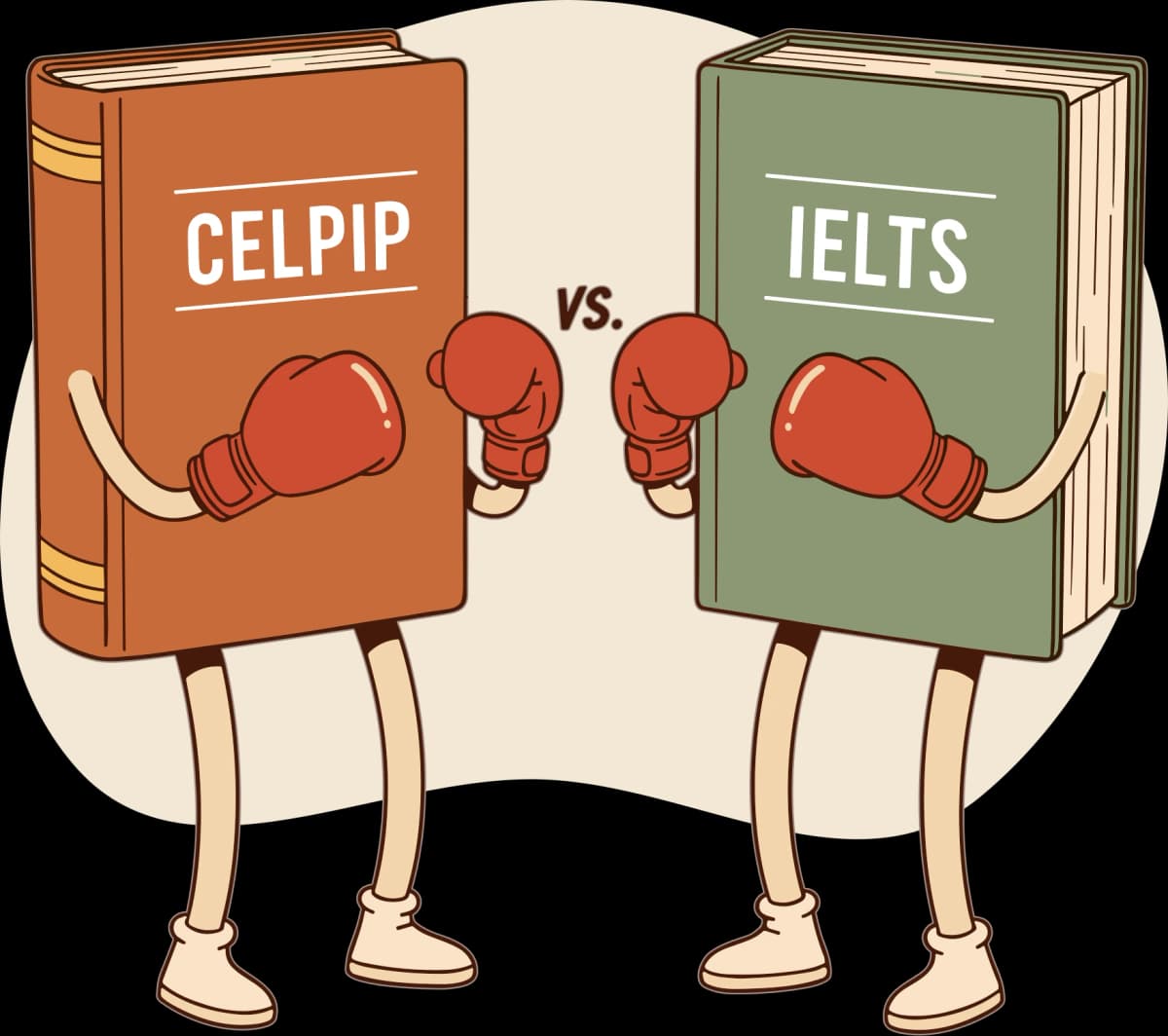
CELPIP vs IELTS

CELPIP or IELTS — which fits you?

Both tests are IRCC-accepted for Canadian PR and citizenship. The right pick comes down to format, accent, and where you're headed — here's the side-by-side breakdown.

  • Both IRCC-accepted
  • CELPIP = computer + Canadian English
  • IELTS = paper option + live interview
celpip-vs-ielts-hero

Side-by-side comparison

How CELPIP and IELTS compare on format, scoring, accent, and acceptance.

CELPIPIELTS
FormatComputer-based, single sittingPaper or computer; in-person speaking interview
Duration~3 hours (LS: ~1h 10m)~2h 45m (Speaking is a separate appointment)
AccentCanadian English throughoutMix: British, Australian, North American
SpeakingRecorded computer prompts (8 tasks)Live face-to-face interview (3 parts)
Writing2 tasks (email + opinion response)2 tasks (Task 1 + essay)
Scoring1–12 per skill (CLB-aligned)0–9 per skill
Accepted byIRCC, Canadian citizenship, Canadian professional bodiesIRCC, universities worldwide, US, UK, AU, NZ
Best forCanadian immigration & citizenship; Canadian contextStudy abroad + immigration to multiple countries

Skill by skill

How CELPIP and IELTS differ on each of the four skills — with the score each maps to on the Canadian Language Benchmarks (CLB).

Reading

Both use multiple-choice questions, but CELPIP's passages lean on Canadian workplace and community contexts — the emails, notices, and articles you'd actually meet in Canada. IELTS General Training reading pulls from a wider international mix. The question styles are similar; the real difference is how familiar the context feels.

Score targets
CLB 9CELPIP 9IELTS 7.0
CLB 7CELPIP 7IELTS 6.0

Writing

CELPIP writing is two typed tasks — an email and a survey/opinion response. IELTS General Training is also two tasks — a letter and an essay — which you can hand-write or type. CELPIP's email mirrors everyday Canadian correspondence, while the IELTS essay leans more formal and academic.

Score targets
CLB 9CELPIP 9IELTS 7.0
CLB 7CELPIP 7IELTS 6.0

Listening

CELPIP uses only Canadian English across conversations, news items, and discussions, played once. IELTS mixes British, Australian, and North American accents. If you've been living in or preparing for Canada, CELPIP's single accent is often easier to follow — note IELTS sets a higher bar here, needing 8.0 for CLB 9 versus 7.0 in the other skills.

Score targets
CLB 9CELPIP 9IELTS 8.0
CLB 7CELPIP 7IELTS 6.0

Speaking

This is the biggest format gap. CELPIP speaking is eight recorded tasks — you speak into a microphone against a timer, with no examiner in the room. IELTS speaking is a live, face-to-face interview in three parts. Prefer thinking on your feet with a real person? IELTS. Prefer a private, examiner-free booth? CELPIP.

Score targets
CLB 9CELPIP 9IELTS 7.0
CLB 7CELPIP 7IELTS 6.0

Go deeper:Full CLB conversion chartCompare all four test scoresCELPIP study tips & practice

Which one should you take?

Match the test to your goal — not the other way around.

CELPIP

Choose CELPIP if…

  • Your goal is Canadian PR, citizenship, or a Canadian professional designation
  • You prefer one computer-based sitting with no live interview
  • Canadian English and CLB-aligned scoring play to your strengths
IELTS

Choose IELTS if…

  • You're applying to universities or immigrating to multiple countries
  • You need Academic scores for study (CELPIP has no academic version)
  • You're more comfortable speaking with a live examiner

Also weighing PTE Core? See the full CELPIP vs PTE Core breakdown

CELPIP vs IELTS FAQ

The questions test-takers ask most when choosing between the two.

Is CELPIP easier than IELTS?

Neither is universally easier — it depends on your strengths. CELPIP is fully computer-based and uses everyday Canadian English, which suits test-takers comfortable typing and familiar with North American accents. IELTS offers a paper option and a live, face-to-face speaking interview, which some find less stressful than recording answers. For Canadian immigration specifically, most candidates find CELPIP's Canadian-context tasks more intuitive.

Which test does IRCC accept for Canadian PR and citizenship?

Both. IRCC accepts CELPIP-General and IELTS General Training for permanent residence (Express Entry, PNP) and citizenship. CELPIP is Canada-only, while IELTS is also accepted by thousands of institutions worldwide — so if you may also study or immigrate abroad, IELTS keeps more doors open.

How do CELPIP and IELTS scores convert to CLB levels?

Both map to the Canadian Language Benchmarks (CLB), which is what IRCC actually scores. As a rough guide: CLB 9 ≈ CELPIP 9 ≈ IELTS 7.0 (Listening 8.0); CLB 7 ≈ CELPIP 7 ≈ IELTS 6.0. Because the bands don't line up one-to-one across all four skills, always check the official CLB conversion chart for the skill and level you need rather than assuming a flat equivalence.

How much do CELPIP and IELTS cost in Canada?

Both sit in a similar range — roughly CAD $280–$320 per sitting depending on the test centre and date. Price alone is rarely the deciding factor; availability of test dates near you and how quickly you need results usually matter more.

Can I use CELPIP for university admission?

No. CELPIP has no academic version, so universities that require an English test for admission generally ask for IELTS Academic, TOEFL, or PTE Academic. Use CELPIP for immigration and citizenship; use IELTS Academic if your goal is study at a college or university.

How fast do I get my results?

CELPIP results are typically available online within about 4–5 business days, sometimes faster. IELTS results take about 3–5 days for the computer-delivered test and up to 13 days for paper-based. If you're on a tight immigration deadline, the faster turnaround can be a real advantage.

Real score improvements

Test-takers across Canada reaching their target scores.

The AI found that my writing lacked coherence — I kept jumping between ideas. After two weeks of targeted drills, my writing score jumped from 7 to 9.

Priya S.

Priya S.

Scored CLB 7 → 9 · Toronto, ON

My daily tasks were exactly what I needed. The system knew my vocabulary was strong and my grammar was the next skill to level up, so every drill focused there.

Marco L.

Marco L.

Scored CLB 8 → 10 · Vancouver, BC

I only had 2 weeks. The AI mapped my clearest growth areas on day one, and the adaptive plan got me from 6 to 8. Every session went toward skills that still moved my score.

Aisha K.

Aisha K.

Scored CLB 6 → 8 · Calgary, AB

Seeing my predicted score go up each week kept me motivated. The AI feedback on my speaking responses was more useful than any tutor I'd tried.

David C.

David C.

Scored CLB 7 → 9 · Montreal, QC

The score progression chart showed exactly where I was improving and where I had the most room to grow next. I walked into the real test knowing I was ready.

Yuki T.

Yuki T.

Scored CLB 8 → 10 · Ottawa, ON

The AI kept adjusting my plan as I improved. Week one was all grammar drills, but by week three it shifted to full mock tests. Smart system.

Fatima R.

Fatima R.

Scored CLB 6 → 8 · Edmonton, AB

CELPIP Paragon Platinum Member

PARAGON

PLATINUMMEMBER
Official Paragon Platinum Member
2 weeks To Measurable Gains8,500+ Live StudentsOfficial CELPIP Test Partner

Paragon Platinum-certified — the only AI score coach paired with live CELPIP-certified teachers.

AI + Live Teachers

Chosen CELPIP? Let's get
you ready.

  • Live CELPIP-certified teachers
  • AI scoring 24/7
  • Paragon Platinum partnership
See Live Classes

Pick CELPIP and start preparing today.

Most users see measurable improvement within 2 weeks. Start with a free AI diagnosis — it takes 5 minutes.

Start Free Diagnosis

Stop Guessing. Start Knowing.